Biological Diversity

Andrews Forest Monthly Meeting June 4

Event Date: 
Friday, June 4, 2021
Event Brief Description: 

Andrews Forest Monthly Meeting: Friday, June 4, 9-11 AM

For our June 2021 meeting, we will start digging into the theme of interactions, which is the central theme of LTER8. We are going to transition from our discussions of fire over the past four monthly meetings to interactions and microclimates. 
 
Responses of species to environmental change may be mediated by both species interactions and microclimate. Our discussions of fire provides a great lead-in to microclimate as the 2020 fires left patches of differing effects both inside and outside of the H.J. Andrews Experimental Forest in the Cascade Mountain Range. Microclimate conditions create fine-scale heterogeneity across the landscape in forest canopy structure, fine-scale topography, and local habitat conditions, which, in turn, influence species, ecosystems, and their underlying processes. With these talks and conversations, we hope to kick off discussions among the research community around interactions, microclimates, and refugia.   
 
JUNE PRESENTATIONS:
 
Talk 1: Ivan Arismendi: Geophysical templates modulate the structure of stream food webs dominated by omnivory
 
Talk 2: Sarah Frey/Matt Betts: Heterospecific interactions mediate colonization dynamics of birds across a microclimate gradient
 

SCIENCE CAFÉ ABOUT INTERACTIONS
 
After our presentations, we will move into a SCIENCE CAFÉ (with virtual coffee) to discuss the topic of interactions. Everyone is welcome to participate. During this science café, we will host smaller breakout discussions around the theme of interactions at the Andrews Forest to more deeply understand the role of species interactions and microclimates. 
 
Introduction to “Interactions” in LTER8: Matt Betts
 
Breakout room discussions will focus on four topics laid out in LTER8, but we will have multiple rooms around each theme to facilitate conversation:
 
1)    How forests modulate the expression of regional climate to create local microclimate patterns in mountains (Moderator: Mark Schulze)
2)    How microclimate and legacies of land use and disturbance influence populations, communities and ecosystem processes (Moderator: Dave Bell)
3)    How species interactions amplify or reduce responses to microclimate (Moderator: Matt Betts)
4)    How values filter the use of science in land use decisions (Moderators: Michael Nelson, Chelsea Batavia)
 
We will then reconvene to briefly describe discussions in the breakout rooms.

Our meetings follow the academic year. Next meeting: October 1, 2021.  9-11 AM. 

Contact Lina DiGregorio for Zoom link.

Andrews Forest Monthly Meeting June 4

Event Date: 
Friday, June 4, 2021
Event Brief Description: 

Andrews Forest Monthly Meeting: Friday, June 4, 9-11 AM

For our June 2021 meeting, we will start digging into the theme of interactions, which is the central theme of LTER8. We are going to transition from our discussions of fire over the past four monthly meetings to interactions and microclimates. 
 
Responses of species to environmental change may be mediated by both species interactions and microclimate. Our discussions of fire provides a great lead-in to microclimate as the 2020 fires left patches of differing effects both inside and outside of the H.J. Andrews Experimental Forest in the Cascade Mountain Range. Microclimate conditions create fine-scale heterogeneity across the landscape in forest canopy structure, fine-scale topography, and local habitat conditions, which, in turn, influence species, ecosystems, and their underlying processes. With these talks and conversations, we hope to kick off discussions among the research community around interactions, microclimates, and refugia.   
 
JUNE PRESENTATIONS:
 
Talk 1: Ivan Arismendi: Geophysical templates modulate the structure of stream food webs dominated by omnivory
 
Talk 2: Sarah Frey/Matt Betts: Heterospecific interactions mediate colonization dynamics of birds across a microclimate gradient
 

SCIENCE CAFÉ ABOUT INTERACTIONS
 
After our presentations, we will move into a SCIENCE CAFÉ (with virtual coffee) to discuss the topic of interactions. Everyone is welcome to participate. During this science café, we will host smaller breakout discussions around the theme of interactions at the Andrews Forest to more deeply understand the role of species interactions and microclimates. 
 
Introduction to “Interactions” in LTER8: Matt Betts
 
Breakout room discussions will focus on four topics laid out in LTER8, but we will have multiple rooms around each theme to facilitate conversation:
 
1)    How forests modulate the expression of regional climate to create local microclimate patterns in mountains (Moderator: Mark Schulze)
2)    How microclimate and legacies of land use and disturbance influence populations, communities and ecosystem processes (Moderator: Dave Bell)
3)    How species interactions amplify or reduce responses to microclimate (Moderator: Matt Betts)
4)    How values filter the use of science in land use decisions (Moderators: Michael Nelson, Chelsea Batavia)
 
We will then reconvene to briefly describe discussions in the breakout rooms.

Our meetings follow the academic year. Next meeting: October 1, 2021.  9-11 AM. 

Contact Lina DiGregorio for Zoom link.

Student Spotlight Hankyu Kim

News Brief Description: 

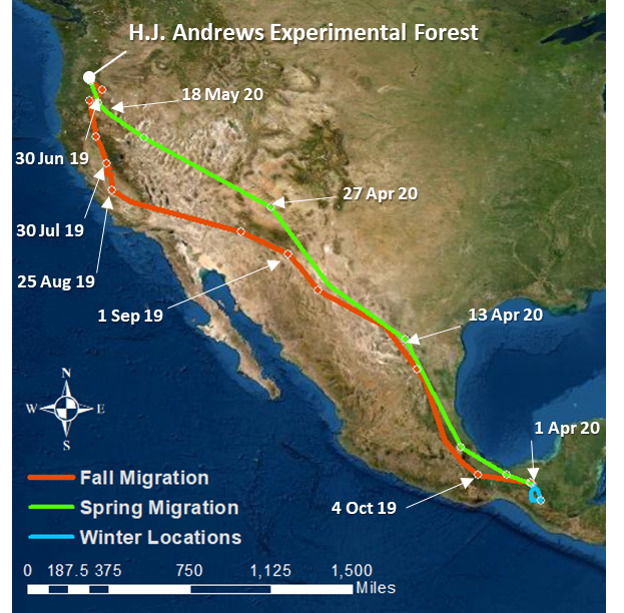
Hankyu Kim studies birds, microclimate, and forest vegetation as a part of ongoing long-term ecological research on songbird populations at the Andrews Forest. Using long-term data, Hankyu is testing if forest microclimate can predict breeding bird population dynamics, and how the interaction of forest composition and structure regulate bird population trends. Hankyu also is studying the migration ecology of Hermit Warblers, a bird that needs mature coniferous forests for breeding. To track the birds’ movements, Hankyu put data loggers on the backs of Hermit Warblers captured on their breeding grounds at the Andrews Forest and across Pacific Northwest. Preliminary data suggests that the birds from the Andrews Forest migrate to areas of Mexico around the Yucatan Peninsula. Finally, Hankyu has studied terrestrial breeding bird population change in South Korea, linking their population dynamics with large-scale land-use change and climate change in the past two decades. Hankyu is a PhD student in OSU’s Department of Forest Ecosystems and Society, working with Matt Betts and Brenda McComb.

migration map of a hermit warbler
One of the Hermit Warblers banded at the Andrews Forest moved through a round-trip route of 6,475 miles, or 10,422 km (5,446 km in fall, 4,976 km in spring). The fall migration took approximately 3 months. Spring migration took approximately 50 days. The birds race toward breeding grounds in spring, moving about 100km per day on average, but during fall, the migration route is longer and slower as the birds need to molt their feathers on the early part of their migration.


Thesis Defense: Stephen Calkins. Hemlock Dwarf Mistletoe. July 24

Event Date: 
Friday, July 24, 2020
Event Brief Description: 
Stephen Calkins M.S. Defense on Friday, July 24 at 9:00 AM via Zoom. 
 
Stephen will present his thesis, “Transformation of Western Hemlock Tree Crowns by Dwarf Mistletoe”.  Stephen is pursuing his graduate degree in Sustainable Forest Management with major professor, Dr. Dave Shaw.
 
 To participate, please contact Stephen for Zoom details.
 
To see images of Stephen and his field work at the Andrews Forest, see the Dwarf Mistletoe Survey 2019 image gallery

Andrews Forest Monthly Meeting, March 6

Event Date: 
Friday, March 6, 2020
Event Brief Description: 

Presentations:

“Breeding bird population trends and wintering ground connectivity of Hermit Warblers in HJ Andrews” presented by Hankyu Kim, PhD student, Department of Forest Ecosystems and Society. 

“Biodiversity of the HJ Andrews Experimental Forest and surrounding Willamette National Forest” presented by Marie Tosa, PhD student, Department of Fisheries and Wildlife. 

LTER Graduate student flash presentation: “Causal mechanisms of midday dip in soil respiration from DIRT plots” presented by Hayley Peter-Contesse, PhD student, Department of Crop and Soil Sciences.

This meeting is organized and hosted by our graduate student representatives, Allison Swartz and Marie Tosa. 

Monthly meetings are used to share science, news, and opportunities related to the HJ Andrews Experimental Forest and Long-Term Ecological Research program. We start with a science hour and then move into program news and announcements. Anyone is welcome to attend.  Monthly meetings are on the first Friday of the month during the academic year, from 9 AM - 11 AM. The next meetings will be April 3, May 1, June 5. 

9-11 AM, Forestry Sciences Lab, 3200 SW Jefferson Way, Room 20

Andrews Forest Monthly Meeting, Feb 7

Event Date: 
Friday, February 7, 2020
Event Brief Description: 

Presentations:

“Northern Spotted Owl: long-term research and population demography monitoring.” presented by Damon Lesmeister, Research Wildlife Biologist, USDA Forest Service, Pacific Northwest Research Station

“Northern Spotted Owl (Strix occidentalis caurina) population demography on the Willamette National Forest: observations from the field.” presented by Steve Ackers, Senior Faculty Research Assistant, Dept. of Fisheries and Wildlife, OSU

LTER Graduate student flash presentation: "Using long term data to understand stream channel recovery after a large flood."  presented by Arianna Goodman, Department of Forest Engineering, Resources & Management

Monthly meetings are used to share science, news, and opportunities related to the HJ Andrews Experimental Forest and Long-Term Ecological Research program. We start with a science hour and then move into program news and announcements. Anyone is welcome to attend.  Monthly meetings are on the first Friday of the month during the academic year, from 9 AM - 11 AM. The next meetings will be March 6, April 3, May 1, June 5. 

9-11 AM, Forestry Sciences Lab, 3200 SW Jefferson Way, Room 20

Pages