
Image Search
| Thumbnail | Media name | Gallery | Keyword Tags | Caption | Photographed date Sort ascending |
|---|---|---|---|---|---|
|
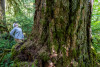
age_016.jpg | Forests of Oregon Elevation Gradient (FOREG) 2026 | Vegetation, Biological Diversity | Technician Claire Kubacki checks the health status of a large Douglas fir (Pseudotsuga menziesii) in FOREG-38 |
|
|
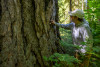
age_017.jpg | Forests of Oregon Elevation Gradient (FOREG) 2026 | Vegetation, Biological Diversity | Claire Kubacki checking the number on the tree tag for a large Douglas fir (Pseudotsuga menziesii) |
|
|
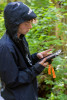
age_018.jpg | Forests of Oregon Elevation Gradient (FOREG) 2026 | Vegetation, Biological Diversity | Technician Jack Shultz records data |
|
|
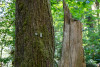
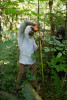
age_019.jpg | Forests of Oregon Elevation Gradient (FOREG) 2026 | Vegetation, Biological Diversity | Tagged trees in FOREG-38. The double tag indicates that the tree is part of the Big Plots study and the long-term Permanent Study Plot study, while the folded tag indicates the tree is dead |
|
|
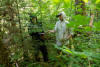
age_020.jpg | Forests of Oregon Elevation Gradient (FOREG) 2026 | Vegetation, Biological Diversity | Technician Gio D'Innocente measures where to mark and measure the diameter of a big leaf maple (Acer macrophyllum) |
|
|
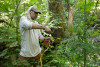
age_021.jpg | Forests of Oregon Elevation Gradient (FOREG) 2026 | Vegetation, Biological Diversity | Technicians working in a dense plot along Lookout Creek measuring a patch of red huckleberries (Vaccinium parvifolium) with calipers |
|
|
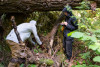
age_022.jpg | Forests of Oregon Elevation Gradient (FOREG) 2026 | Vegetation, Biological Diversity | Technician Gio D'Innocente uses calipers to measure the diameter of a red huckleberry (Vaccinium parvifolium) |
|
|
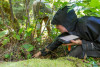
age_023.jpg | Forests of Oregon Elevation Gradient (FOREG) 2026 | Vegetation, Biological Diversity | Technicians search for missing tagged trees, which had been crushed by a large fallen Douglas fir (Pseudotsuga menziesii) |
|
|
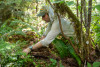
age_024.jpg | Forests of Oregon Elevation Gradient (FOREG) 2026 | Vegetation, Biological Diversity | Technicians looking for missing tree tags, which were marked on trees five years prior and now have fallen on the ground |
|
|
age_025.jpg | Forests of Oregon Elevation Gradient (FOREG) 2026 | Vegetation, Biological Diversity | Technician Gio D'Innocente looking for missing tree tags for a hazelnut (Corylus cornuta var. californica) patch, which were marked on trees five years prior and now have fallen on the ground |
|
|
age_026.jpg | Forests of Oregon Elevation Gradient (FOREG) 2026 | Vegetation, Biological Diversity | Looking up into the canopy |
|
|
age_027.jpg | Forests of Oregon Elevation Gradient (FOREG) 2026 | Vegetation, Biological Diversity | The study plot (FOREG-38) |
|
|
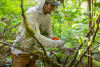
age_028.jpg | Forests of Oregon Elevation Gradient (FOREG) 2026 | Vegetation, Biological Diversity | Technician Gio D'Innocente uses a diameter tape to measure a hazelnut tree (Corylus cornuta var. californica) in the plot |
|
|
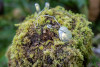
age_029.jpg | Forests of Oregon Elevation Gradient (FOREG) 2026 | Vegetation, Biological Diversity | Tree tags that will be assigned to new trees as they "in-growth" into the plot when they become 1 cm in diameter |
|
|
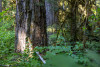
age_030.jpg | Forests of Oregon Elevation Gradient (FOREG) 2026 | Vegetation, Biological Diversity | Large Douglas firs (Pseudotsuga menziesii) in FOREG-38 |
|
|
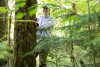
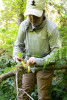
age_001.jpg | Forests of Oregon Elevation Gradient (FOREG) 2026 | Vegetation, Biological Diversity | Technician Claire Kubacki measures the diameter of a western hemlock (Tsuga heterophylla) in FOREG-38 |
|
|
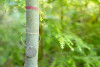
age_002.jpg | Forests of Oregon Elevation Gradient (FOREG) 2026 | Vegetation, Biological Diversity | Technician Claire Kubacki measures the diameter of a vine maple tree (Acer circinatum), growing sideways, in FOREG-38 |
|
|
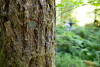
age_003.jpg | Forests of Oregon Elevation Gradient (FOREG) 2026 | Vegetation, Biological Diversity | Vine maple (Acer circinatum) recently tagged and marked with markal paint stick to indicate it was measured and recorded |
|
|
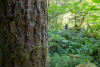
age_004.jpg | Forests of Oregon Elevation Gradient (FOREG) 2026 | Vegetation, Biological Diversity | A tagged tree in FOREG-38 |
|
|
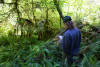
age_005.jpg | Forests of Oregon Elevation Gradient (FOREG) 2026 | Vegetation, Biological Diversity | A tagged tree in FOREG-38 with technicians working in the plot |
|
|
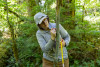
age_006.jpg | Forests of Oregon Elevation Gradient (FOREG) 2026 | Vegetation, Biological Diversity | Measuring and recording tree diameter and health conditions |
|
|
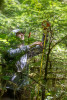
age_007.jpg | Forests of Oregon Elevation Gradient (FOREG) 2026 | Vegetation, Biological Diversity | Technician Claire Kubacki measures and marks a vine maple (Acer circinatum) |
|
|
age_008.jpg | Forests of Oregon Elevation Gradient (FOREG) 2026 | Vegetation, Biological Diversity | Technician Claire Kubacki measures a small western hemlock (Tsuga heterophylla) in FOREG38 |
|
|
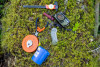
age_009.jpg | Forests of Oregon Elevation Gradient (FOREG) 2026 | Vegetation, Biological Diversity | Tools of the trade--diameter tape, wire clippers, markal paint stick, calipers, compass, tree tags, wire |
|
|
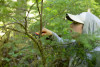
age_010.jpg | Forests of Oregon Elevation Gradient (FOREG) 2026 | Vegetation, Biological Diversity | Technician Claire Kubacki uses calipers to measure the diameter of a small western hemlock (Tsuga heterophylla) in the study plot |
|
|
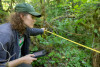
age_011.jpg | Forests of Oregon Elevation Gradient (FOREG) 2026 | Vegetation, Biological Diversity | Technician Amelia Leonard measures distance from an established tree to a tree that is being added to the study now that it is large enough |
|
|
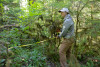
age_012.jpg | Forests of Oregon Elevation Gradient (FOREG) 2026 | Vegetation, Biological Diversity | Technician Claire Kubacki measures the distance between trees |
|
|
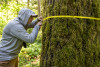
age_013.jpg | Forests of Oregon Elevation Gradient (FOREG) 2026 | Vegetation, Biological Diversity | Technician Claire Kubacki measures the diameter of a large Douglas fir (Pseudotsuga menziesii) tree |
|
|
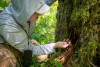
age_014.jpg | Forests of Oregon Elevation Gradient (FOREG) 2026 | Vegetation, Biological Diversity | A check at the base of a hemlock (Tsuga heterophylla) reveals rot inside the trunk |
|
|
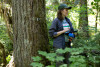
age_015.jpg | Forests of Oregon Elevation Gradient (FOREG) 2026 | Vegetation, Biological Diversity | Technician Amelia Leonard records data |
|
|
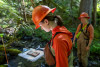
agd_015.jpg | Post Fire Stream Nutrient Dynamics 2026 | Stream Ecology, Hydrology, Carbon and Nutrient Dynamics | REU student Katie Hovind measures canopy cover over the streambed using a densiometer |
|
|
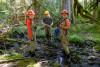
agd_014.jpg | Post Fire Stream Nutrient Dynamics 2026 | Stream Ecology, Hydrology, Carbon and Nutrient Dynamics | REU student Katie Hovind, graduate student Maeve Bittle, and REU student Emma Cooper working in McCrae Creek at the HJA |
|
|
agd_016.jpg | Post Fire Stream Nutrient Dynamics 2026 | Stream Ecology, Hydrology, Carbon and Nutrient Dynamics | REU student Katie Hovind measures canopy cover over the streambed using a densiometer |
|
|
agd_017.jpg | Post Fire Stream Nutrient Dynamics 2026 | Stream Ecology, Hydrology, Carbon and Nutrient Dynamics | REU student Katie Hovind measures canopy cover over the streambed using a densiometer |
|
|
agd_018.jpg | Post Fire Stream Nutrient Dynamics 2026 | Stream Ecology, Hydrology, Carbon and Nutrient Dynamics | REU student Emma Cooper inspects a rock with algae in McCrae Creek at the HJA |
|
|
agd_019.jpg | Post Fire Stream Nutrient Dynamics 2026 | Stream Ecology, Hydrology, Carbon and Nutrient Dynamics | REU student Katie Hovind, graduate student Maeve Bittle, REU student Emma Cooper, and Professor Catalina Segura at McCrae Creek at the HJA |
|
|
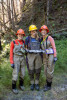
agd_001.jpg | Post Fire Stream Nutrient Dynamics 2026 | Stream Ecology, Hydrology, Carbon and Nutrient Dynamics | REU student Katie Hovind, graduate student Maeve Bittle, and REU student Emma Cooper ready for field work |
|
|
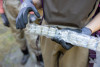
agd_002.jpg | Post Fire Stream Nutrient Dynamics 2026 | Stream Ecology, Hydrology, Carbon and Nutrient Dynamics | Vials used to measure nutrient uptake will be placed in the stream (C for control, N for nitrate, and P for phosphate) |
|
|
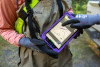
agd_003.jpg | Post Fire Stream Nutrient Dynamics 2026 | Stream Ecology, Hydrology, Carbon and Nutrient Dynamics | Study locations in streams at the HJA, which are in recently burned and unburned watersheds |
|
|
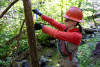
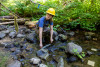
agd_004.jpg | Post Fire Stream Nutrient Dynamics 2026 | Stream Ecology, Hydrology, Carbon and Nutrient Dynamics | REU student Katie Hovind attaches flagging to a tree to mark the location of the experiment along the stream |
|
|
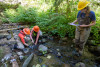
agd_005.jpg | Post Fire Stream Nutrient Dynamics 2026 | Stream Ecology, Hydrology, Carbon and Nutrient Dynamics | Graduate student Maeve Bittle secures vials that will measure nutrient updake in the stream. |
|
|
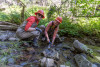
agd_006.jpg | Post Fire Stream Nutrient Dynamics 2026 | Stream Ecology, Hydrology, Carbon and Nutrient Dynamics | REU students and graduate student Maeve Bittle employ sensors, tiles, and vials that will measure nutrient update, stream teampeature, and primary production. |
|
|
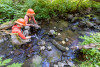
agd_007.jpg | Post Fire Stream Nutrient Dynamics 2026 | Stream Ecology, Hydrology, Carbon and Nutrient Dynamics | REU students Katie Hovind and Emma Cooper working in Nostoc Creek in the HJA |
|
|
agd_008.jpg | Post Fire Stream Nutrient Dynamics 2026 | Stream Ecology, Hydrology, Carbon and Nutrient Dynamics | REU students Katie Hovind and Emma Cooper working in Nostoc Creek in the HJA |
|
|
agd_009.jpg | Post Fire Stream Nutrient Dynamics 2026 | Stream Ecology, Hydrology, Carbon and Nutrient Dynamics | Graduate student Maeve Bittle demonstrates a densiometer, which measures light incidence (canopy cover) above the streambed |
|
|
agd_010.jpg | Post Fire Stream Nutrient Dynamics 2026 | Stream Ecology, Hydrology, Carbon and Nutrient Dynamics | REU student Emma Cooper measures canopy cover over the streambed using a densiometer |
|
|
agd_011.jpg | Post Fire Stream Nutrient Dynamics 2026 | Stream Ecology, Hydrology, Carbon and Nutrient Dynamics | Vials (left), tiles (center), and a temperature sensor measure nutrient update, algal growth (primary productivity) and stream temperature |
|
|
agd_012.jpg | Post Fire Stream Nutrient Dynamics 2026 | Stream Ecology, Hydrology, Carbon and Nutrient Dynamics | REU student Emma Cooper is studying discharge rates from stream culverts at the HJA |
|
|
agd_013.jpg | Post Fire Stream Nutrient Dynamics 2026 | Stream Ecology, Hydrology, Carbon and Nutrient Dynamics | A section of Nostoc Creek being studied for stream nutrient and primary production changes following wildfire |
|
|
aga_010.jpg | Vegetation, Fire Ecology | OSU technician Sy Graber samples the stump in a recently burned area of the forest |
||
|
aga_011.jpg | Vegetation, Fire Ecology | Meg Krawchuk (left), Matthew Betts (center), and Andrew Merschel (right) inspect a sampled tree stump which shows a fire scar from a fire approximately 175 years earlier. |
||
|
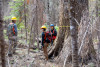
aga_012.jpg | Vegetation, Fire Ecology | Meg Krawchuk (left), Matthew Betts (center), and Andrew Merschel (right) inspect a sampled tree stump which shows a fire scar from a fire approximately 175 years earlier. |
||
|
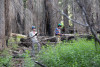
aga_013.jpg | Vegetation, Fire Ecology | Meg Krawchuk (left) and Andrew Merschel (right) inspect a sampled tree stump which shows a fire scar from a fire approximately 175 years earlier. |
||
|
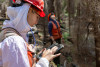
aga_014.jpg | Vegetation, Fire Ecology | Sampled tree stump with a fire scar and additional indicators of structural damage and branching. |
||
|
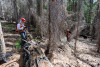
aga_015.jpg | Vegetation, Fire Ecology | Inspecting a sample of wood, showing a fire scar, taken from a tree stump |
||
|
aga_016.jpg | Vegetation, Fire Ecology | Inspecting a sample of wood, showing a fire scar, taken from a tree stump |
||
|
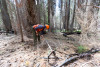
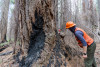
aga_017.jpg | Vegetation, Fire Ecology | OSU technicians Will Scypinski (left) and Amanda Brackett (right) use a chain saw to remove the top of an old stump |
||
|
aga_018.jpg | Vegetation, Fire Ecology | OSU technicians Will Scypinski (left) and Amanda Brackett (right) use a chain saw to remove the top of an old stump |
||
|
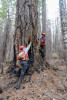
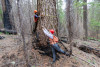
aga_019.jpg | Vegetation, Fire Ecology | After the top of the tree stump is removed, the surface is brushed clean of sawdust so the crew can inspect the tree rings, in search of fire scars. This stump did not show any fire scars. |
||
|
aga_020.jpg | Vegetation, Fire Ecology | After the top of the tree stump is removed, the surface is brushed clean of sawdust so the crew can inspect the tree rings, in search of fire scars. This stump did not show any fire scars. |
||
|
aga_021.jpg | Vegetation, Fire Ecology | Amanda Brackett (left) and Andrew Merschel (right) process the sample from a stump that displays a fire scar. The sample will be taken back to the OSU campus for processing and measuring. |
||
|
aga_022.jpg | Vegetation, Fire Ecology | Andrew Merschel cleans off a samples stump to reveal fire scars |
||
|
aga_023.jpg | Vegetation, Fire Ecology | Andrew Merschel points out the vertical fire scar--the dark vertical line of wood--in the sampled stump |
||
|
aga_024.jpg | Vegetation, Fire Ecology | A sampled stump and the tools of the trade -- chain saw, wedge, hatchet |
||
|
aga_025.jpg | Vegetation, Fire Ecology | Andrew Merschel makes final cuts on a sample to be taken back to the Tree Ring Lab on the OSU campus |
||
|
aga_026.jpg | Vegetation, Fire Ecology | Andrew Merschel makes final cuts on a sample to be taken back to the Tree Ring Lab on the OSU campus |
||
|
aga_027.jpg | Vegetation, Fire Ecology | OSU technician Zoe Beard with a sample taken from a stump, showing a fire scar |
||
|
aga_028.jpg | Vegetation, Fire Ecology | A hatchet is used to test if the wood of the stump is sound enough to warrant sampling. |
||
|
aga_029.jpg | Vegetation, Fire Ecology | OSU technician Will Scypinski uses a chain saw to remove the top of a tree stump to reveal the growth rings of the wood, and possibly evidence of fire scars |
||
|
aga_030.jpg | Vegetation, Fire Ecology | OSU technician Will Scypinski uses a chain saw to remove the top of a tree stump to reveal the growth rings of the wood, and possibly evidence of fire scars |
||
|
aga_031.jpg | Vegetation, Fire Ecology | OSU technician Will Scypinski uses a chain saw to remove the top of a tree stump to reveal the growth rings of the wood, and possibly evidence of fire scars |
||
|
aga_032.jpg | Vegetation, Fire Ecology | After the top of the tree stump is removed, the surface is brushed clean of sawdust so the crew can inspect the tree rings, in search of fire scars. This stump did not show any fire scars. |
||
|
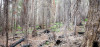
aga_033.jpg | Vegetation, Fire Ecology | Delicate samples are wrapped for transportation back to the lab on the OSU campus where they will be glued to boards for stability before analysis. |
||
|
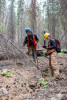
aga_034.jpg | Vegetation, Fire Ecology | Ceanothus integerrimus grows profusely in an area that burned at high severity in the 2020 Holiday Farm Fire |
||
|
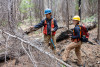
aga_035.jpg | Vegetation, Fire Ecology | Ceanothus integerrimus grows profusely in an area that burned at high severity in the 2020 Holiday Farm Fire |
||
|
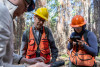
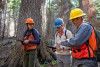
aga_001.jpg | Vegetation, Fire Ecology | A sampled stump. The wedge, top left, will be taken back to the OSU Tree Ring Lab for processing and analysis to determine the year of the fire scar, which appears as a dark ring toward the center of the tree. |
||
|
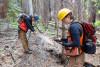
aga_002.jpg | Vegetation, Fire Ecology | OSU Professor Meg Krawchuk looks over a sampled tree stump at the H.J. Andrews Experimental Forest |
||
|
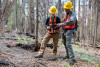
aga_003.jpg | Vegetation, Fire Ecology | A sampled stump. The wedge, top left, will be taken back to the OSU Tree Ring Lab for processing and analysis to determine the year of the fire scar, which appears as a dark ring toward the center of the tree. |
||
|
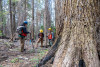
aga_004.jpg | Vegetation, Fire Ecology | Fire history sampling crew from OSU: Will Scypinski, Amanda Brackett, Sy Graber |
||
|
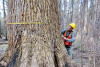
aga_005.jpg | Vegetation, Fire Ecology | The top of a tree stump is cut and then removed, to expose the tree rings. The stump must be cut low to find solid wood, and scars appear more distinctly towards the base of the tree. |
||
|
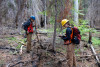
aga_006.jpg | Vegetation, Fire Ecology | After the top of the tree stump is removed, the surface is brushed clean of sawdust so the crew can inspect the tree rings, in search of fire scars. This stump did not show any fire scars. |
||
|
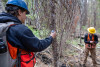
aga_007.jpg | Vegetation, Fire Ecology | This sample reveals a fire scar, with a blackened tree ring bordered by resin and surrounded by curved growth rings of wood in subsequent years |
||
|
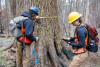
aga_008.jpg | Vegetation, Fire Ecology | Meg Krawchuk (left) looks on as Andrew Merschel points out a fire scar on a sample taken earlier in the day. |
||
|
aga_009.jpg | Vegetation | Western sword fern (Polystichum munitum) and Wood Sorrel (Oxalis oregana). |
||
|
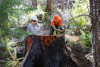
agb_019.jpg | Fire History Project 2026 | Vegetation, Fire Ecology | After the top of the tree stump is removed, the surface is brushed clean of sawdust so the crew can inspect the tree rings, in search of fire scars. This stump did not show any fire scars. |
|
|
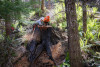
agb_020.jpg | Fire History Project 2026 | Vegetation, Fire Ecology | After the top of the tree stump is removed, the surface is brushed clean of sawdust so the crew can inspect the tree rings, in search of fire scars. This stump did not show any fire scars. |
|
|
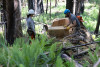
agb_021.jpg | Fire History Project 2026 | Vegetation, Fire Ecology | Amanda Brackett (left) and Andrew Merschel (right) process the sample from a stump that displays a fire scar. The sample will be taken back to the OSU campus for processing and measuring. |
|
|
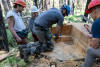
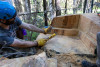
agb_022.jpg | Fire History Project 2026 | Vegetation, Fire Ecology | Andrew Merschel cleans off a samples stump to reveal fire scars |
|
|
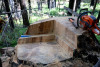
agb_023.jpg | Fire History Project 2026 | Vegetation, Fire Ecology | Andrew Merschel points out the vertical fire scar--the dark vertical line of wood--in the sampled stump |
|
|
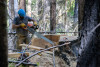
agb_024.jpg | Fire History Project 2026 | Vegetation, Fire Ecology | A sampled stump and the tools of the trade -- chain saw, wedge, hatchet |
|
|
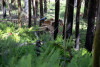
agb_025.jpg | Fire History Project 2026 | Vegetation, Fire Ecology | Andrew Merschel makes final cuts on a sample to be taken back to the Tree Ring Lab on the OSU campus |
|
|
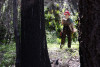
agb_026.jpg | Fire History Project 2026 | Vegetation, Fire Ecology | Andrew Merschel makes final cuts on a sample to be taken back to the Tree Ring Lab on the OSU campus |
|
|
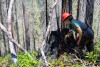
agb_027.jpg | Fire History Project 2026 | Vegetation, Fire Ecology | OSU technician Zoe Beard with a sample taken from a stump, showing a fire scar |
|
|
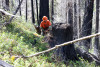
agb_028.jpg | Fire History Project 2026 | Vegetation, Fire Ecology | A hatchet is used to test if the wood of the stump is sound enough to warrant sampling. |
|
|
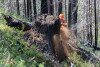
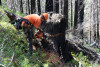
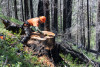
agb_029.jpg | Fire History Project 2026 | Vegetation, Fire Ecology | OSU technician Will Scypinski uses a chain saw to remove the top of a tree stump to reveal the growth rings of the wood, and possibly evidence of fire scars |
|
|
agb_030.jpg | Fire History Project 2026 | Vegetation, Fire Ecology | OSU technician Will Scypinski uses a chain saw to remove the top of a tree stump to reveal the growth rings of the wood, and possibly evidence of fire scars |
|
|
agb_031.jpg | Fire History Project 2026 | Vegetation, Fire Ecology | OSU technician Will Scypinski uses a chain saw to remove the top of a tree stump to reveal the growth rings of the wood, and possibly evidence of fire scars |
|
|
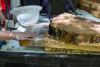
agb_032.jpg | Fire History Project 2026 | Vegetation, Fire Ecology | After the top of the tree stump is removed, the surface is brushed clean of sawdust so the crew can inspect the tree rings, in search of fire scars. This stump did not show any fire scars. |
|
|
agb_033.jpg | Fire History Project 2026 | Vegetation, Fire Ecology | Delicate samples are wrapped for transportation back to the lab on the OSU campus where they will be glued to boards for stability before analysis. |
|
|
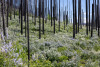
agb_034.jpg | Fire History Project 2026 | Vegetation, Fire Ecology | Ceanothus integerrimus grows profusely in an area that burned at high severity in the 2020 Holiday Farm Fire |
|
|
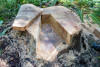
agb_035.jpg | Fire History Project 2026 | Vegetation, Fire Ecology | Ceanothus integerrimus grows profusely in an area that burned at high severity in the 2020 Holiday Farm Fire |
|
|
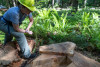
agb_001.jpg | Fire History Project 2026 | Vegetation, Fire Ecology | A sampled stump. The wedge, top left, will be taken back to the OSU Tree Ring Lab for processing and analysis to determine the year of the fire scar, which appears as a dark ring toward the center of the tree. |
|
|
agb_002.jpg | Fire History Project 2026 | Vegetation, Fire Ecology | OSU Professor Meg Krawchuk looks over a sampled tree stump at the H.J. Andrews Experimental Forest |
|
|
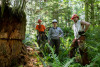
agb_003.jpg | Fire History Project 2026 | Vegetation, Fire Ecology | A sampled stump. The wedge, top left, will be taken back to the OSU Tree Ring Lab for processing and analysis to determine the year of the fire scar, which appears as a dark ring toward the center of the tree. |
|
|
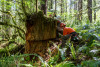
agb_004.jpg | Fire History Project 2026 | Vegetation, Fire Ecology | Fire history sampling crew from OSU: Will Scypinski, Amanda Brackett, Sy Graber |
|
|
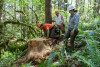
agb_005.jpg | Fire History Project 2026 | Vegetation, Fire Ecology | The top of a tree stump is cut and then removed, to expose the tree rings. The stump must be cut low to find solid wood, and scars appear more distinctly towards the base of the tree. |
|
|
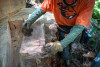
agb_006.jpg | Fire History Project 2026 | Vegetation, Fire Ecology | After the top of the tree stump is removed, the surface is brushed clean of sawdust so the crew can inspect the tree rings, in search of fire scars. This stump did not show any fire scars. |
|
|
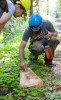
agb_007.jpg | Fire History Project 2026 | Vegetation, Fire Ecology | This sample reveals a fire scar, with a blackened tree ring bordered by resin and surrounded by curved growth rings of wood in subsequent years |
|
|
agb_008.jpg | Fire History Project 2026 | Vegetation, Fire Ecology | Meg Krawchuk (left) looks on as Andrew Merschel points out a fire scar on a sample taken earlier in the day. |
|
|
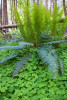
agb_009.jpg | Fire History Project 2026 | Vegetation | Western sword fern (Polystichum munitum) and Wood Sorrel (Oxalis oregana). |
|
|
agb_010.jpg | Fire History Project 2026 | Vegetation, Fire Ecology | OSU technician Sy Graber samples the stump in a recently burned area of the forest |
|
|
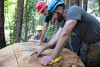
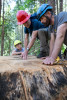
agb_011.jpg | Fire History Project 2026 | Vegetation, Fire Ecology | Meg Krawchuk (left), Matthew Betts (center), and Andrew Merschel (right) inspect a sampled tree stump which shows a fire scar from a fire approximately 175 years earlier. |
|
|
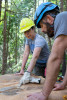
agb_012.jpg | Fire History Project 2026 | Vegetation, Fire Ecology | Meg Krawchuk (left), Matthew Betts (center), and Andrew Merschel (right) inspect a sampled tree stump which shows a fire scar from a fire approximately 175 years earlier. |
|
|
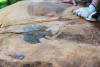
agb_013.jpg | Fire History Project 2026 | Vegetation, Fire Ecology | Meg Krawchuk (left) and Andrew Merschel (right) inspect a sampled tree stump which shows a fire scar from a fire approximately 175 years earlier. |
|
|
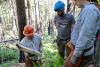
agb_014.jpg | Fire History Project 2026 | Vegetation, Fire Ecology | Sampled tree stump with a fire scar and additional indicators of structural damage and branching. |
|
|
agb_015.jpg | Fire History Project 2026 | Vegetation, Fire Ecology | Inspecting a sample of wood, showing a fire scar, taken from a tree stump |
|
|
agb_016.jpg | Fire History Project 2026 | Vegetation, Fire Ecology | Inspecting a sample of wood, showing a fire scar, taken from a tree stump |
|
|
agb_017.jpg | Fire History Project 2026 | Vegetation, Fire Ecology | OSU technicians Will Scypinski (left) and Amanda Brackett (right) use a chain saw to remove the top of an old stump |
|
|
agb_018.jpg | Fire History Project 2026 | Vegetation, Fire Ecology | OSU technicians Will Scypinski (left) and Amanda Brackett (right) use a chain saw to remove the top of an old stump |
|
|
afx_118.jpg | Reciprocal Transplant Field Work 2024 | Biological Diversity, Vegetation | The lichen reciprocal transplant experiment involves hanging different species of lichen anchored into embroidery hoops, one hoop from each tree has a tempurature reader attached |
|
|
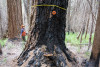
aga_059.jpg | Vegetation Studies 2025 | Vegetation, Regional Research, Biological Diversity, Disturbance | Field technician Melissa Mauk records the diameter of a live overstory tree in the study plot |
|
|
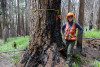
aga_060.jpg | Vegetation Studies 2025 | Vegetation, Regional Research, Biological Diversity, Disturbance | Field technician Melissa Mauk records the diameter of a live overstory tree in the study plot |
|
|
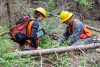
aga_070.jpg | Vegetation Studies 2025 | Vegetation, Regional Research, Biological Diversity, Disturbance | Undergraduate researcher Spencer Jackson and project lead Andy Bluhm look for the metal tag of a tree that burned in the 2023 Lookout Fire |
|
|
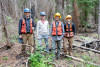
aga_071.jpg | Vegetation Studies 2025 | Vegetation, Regional Research, Biological Diversity, Disturbance | Jack Horton, Ruric Bowman, Andy Bluhm, Spencer Jackson |
|
|
aga_072.jpg | Vegetation Studies 2025 | Vegetation, Regional Research, Biological Diversity, Disturbance | RS21 in the HJ Andrews Experimental Forest, July 2025 |
|
|
aga_077.jpg | Vegetation Studies 2025 | Vegetation, Regional Research, Biological Diversity, Disturbance | Mature forest along Lookout Creek in the HJ Andrews Experimental Forest |
|
|
aga_078.jpg | Vegetation Studies 2025 | Vegetation, Regional Research, Biological Diversity, Disturbance | Mature forest along Lookout Creek in the HJ Andrews Experimental Forest |
|
|
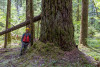
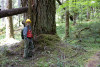
aga_079.jpg | Vegetation Studies 2025 | Vegetation, Regional Research, Biological Diversity, Disturbance | Andy Bluhm next to one of the bigger trees in the HJ Andrews Experimental Forest |
|
|
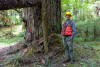
aga_080.jpg | Vegetation Studies 2025 | Vegetation, Regional Research, Biological Diversity, Disturbance | Andy Bluhm next to one of the bigger trees in the HJ Andrews Experimental Forest |
|
|
aga_081.jpg | Vegetation Studies 2025 | Vegetation, Regional Research, Biological Diversity, Disturbance | Andy Bluhm next to one of the bigger trees in the HJ Andrews Experimental Forest |
|
|
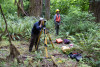
aga_082.jpg | Vegetation Studies 2025 | Vegetation, Regional Research, Biological Diversity, Disturbance | Mature forest along Lookout Creek in the HJ Andrews Experimental Forest |
|
|
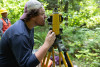
aga_083.jpg | Vegetation Studies 2025 | Vegetation, Regional Research, Biological Diversity, Disturbance | Student researcher Kian Howe records stem distance for mapping using a laser survey tool (total station) |
|
|
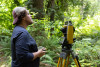
aga_085.jpg | Vegetation Studies 2025 | Vegetation, Regional Research, Biological Diversity, Disturbance | Student researcher Kian Howe records stem distance for mapping using a laser survey tool (total station) |
|
|
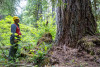
aga_086.jpg | Vegetation Studies 2025 | Vegetation, Regional Research, Biological Diversity, Disturbance | Student researcher Kian Howe records stem distance for mapping using a laser survey tool (total station) |
|
|
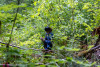
aga_087.jpg | Vegetation Studies 2025 | Vegetation, Regional Research, Biological Diversity, Disturbance | Andy Bluhm next to one of the bigger trees in the HJ Andrews Experimental Forest |
|
|
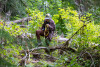
aga_088.jpg | Vegetation Studies 2025 | Vegetation, Regional Research, Biological Diversity, Disturbance | Researcher Gabby Robinson records information on each woody plant in the study plot with a diameter larger than 1 cm |
|
|
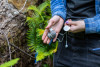
aga_089.jpg | Vegetation Studies 2025 | Vegetation, Regional Research, Biological Diversity, Disturbance | Researcher Kate Forsman moves through Reference Stand 38, with a tape to measure tree diameter |
|
|
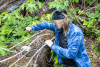
aga_090.jpg | Vegetation Studies 2025 | Vegetation, Regional Research, Biological Diversity, Disturbance | New tree tags, attached to trees that will become part of the long-term study |
|
|
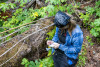
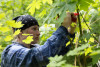
aga_091.jpg | Vegetation Studies 2025 | Vegetation, Regional Research, Biological Diversity, Disturbance | Researcher Gabby Robinson uses a caliper to measure the diameter of a tree in the study plot RS38 |
|
|
aga_092.jpg | Vegetation Studies 2025 | Vegetation, Regional Research, Biological Diversity, Disturbance | Researcher Gabby Robinson records the diameter of a tree in the study plot RS38 |
|
|
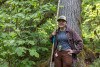
aga_093.jpg | Vegetation Studies 2025 | Vegetation, Regional Research, Biological Diversity, Disturbance | Researcher Gabby Robinson flags a tree that will later be mapped as part of the study |
|
|
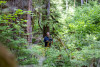
aga_094.jpg | Vegetation Studies 2025 | Vegetation, Regional Research, Biological Diversity, Disturbance | Researcher Kate Forsman holds a marked up PVC pipe used with the laser tool to map out tree stems in a plot |
|
|
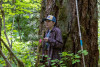
aga_095.jpg | Vegetation Studies 2025 | Vegetation, Regional Research, Biological Diversity, Disturbance | Student researcher Kian Howe records stem distance for mapping using a laser survey tool (total station) |
|
|
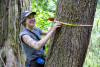
aga_096.jpg | Vegetation Studies 2025 | Vegetation, Regional Research, Biological Diversity, Disturbance | Researcher Kate Forsman reads off information about the tree behind her that will become part of the long term study. Species, size, condition. |
|
|
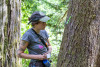
aga_097.jpg | Vegetation Studies 2025 | Vegetation, Regional Research, Biological Diversity, Disturbance | Researcher Sydney Gastman records diameter of a tree in the study plot RS38 |
|
|
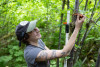
aga_098.jpg | Vegetation Studies 2025 | Vegetation, Regional Research, Biological Diversity, Disturbance | Researcher Sydney Gastman records the tree tag number of a tree in the study plot RS38 |
|
|
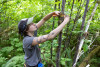
aga_099.jpg | Vegetation Studies 2025 | Vegetation, Regional Research, Biological Diversity, Disturbance | Researcher Sydney Gastman uses a wax pencil to mark the height at which she'll measure the diameter of this small tree |
|
|
aga_100.jpg | Vegetation Studies 2025 | Vegetation, Regional Research, Biological Diversity, Disturbance | Researcher Sydney Gastman measures tree diameter |
|
|
aga_101.jpg | Vegetation Studies 2025 | Vegetation, Regional Research, Biological Diversity, Disturbance | Researcher Kate Forsman holds a PVC pipe that is marked and used with the laser tool to map out tree stems in a plot |
|
|
aga_102.jpg | Vegetation Studies 2025 | Vegetation, Canopy Ecology | Samples of Douglas fir being measured for water potential. |