
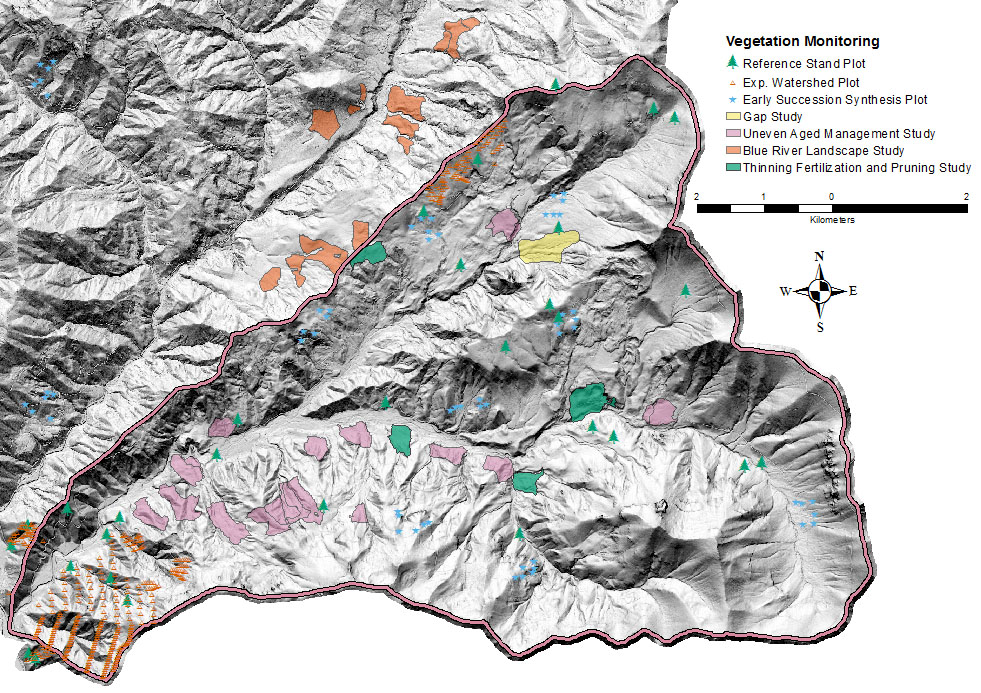
Reference Stands
There are 38 permanent sample plots in and adjacent to the H.J. Andrews Experimental Forest in unmanaged forest stands. This network of plots is part of a larger Permanent Sample Plot network in Oregon and Washington.
TV010 - Long-term growth, mortality and regeneration of trees in permanent vegetation plots in the Pacific Northwest, 1910 to present
Vegetation Plots in Managed and Reference Small Watersheds
In eight of the experimental watersheds vegetation dynamics are studied with systematic small-plot designs. Plot size, arrangement, methods and establishment date vary among the watersheds:
TP073 - Plant succession and biomass dynamics following logging and burning in Watersheds 1 and 3, Andrews Experimental Forest, 1962 to Present
TP041 - Post-logging community structure and biomass accumulation in Watershed 10, Andrews Experimental Forest, 1974 to present
TP114 - Plant biomass dynamics following logging, burning, and thinning in Watersheds 6 and 7, Andrews Experimental Forest, 1979 to present
TP115 - Plant biomass dynamics in old-growth Watersheds 8 and 9 at the Andrews Experimental Forest, 2003 to present
Stand-level Management Studies
TV052 - Forest structure and biomass in early successional harvest units of the Andrews Experimental Forest (ESSA), 1999 to present
Ecoshare Blue River Landscape Strategy
FS123 - Uneven Aged Management Project (UAMP), Andrews Experimental Forest
Young Stand Thinning and Diversity Study
WE008 - Ground-dwelling vertebrates, birds, habitat data on the Willamette National Forest, Oregon (Young Stand Thinning and Diversity Study), 1991-2012
Gap Study
Ecosystem responses to the creation of tree-fall gaps in the western Cascades of Oregon and Washington (Experimental Gap Study), 1990 to 2006