
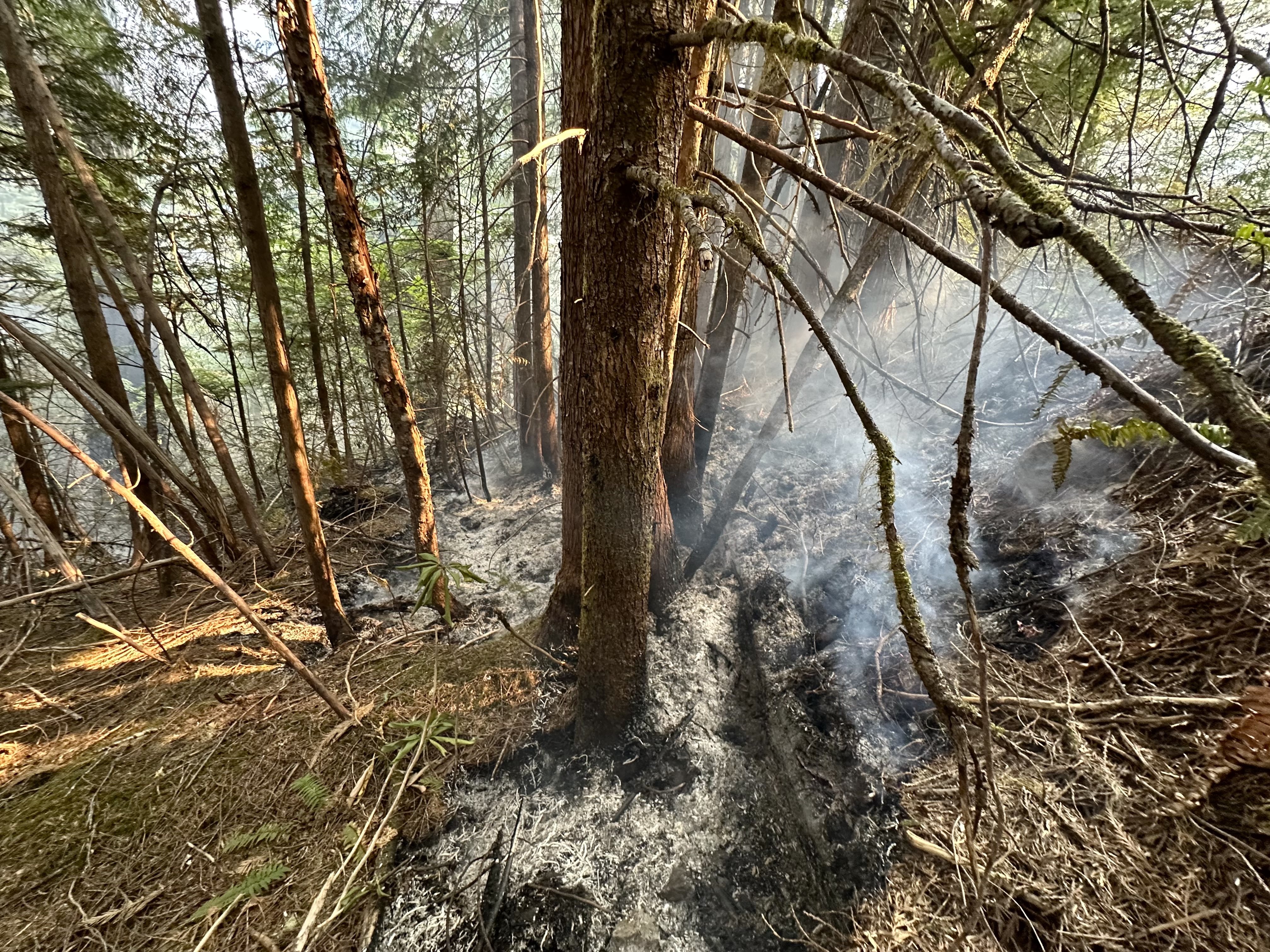
On the west slopes of the Cascades, forest development is shaped by extensive stand-replacing (SR) fires and more frequent fires that cause predominantly non-stand replacing (NSR) effects. These NSR fires generate a complex array of stand structures and forest development pathways within and outside of SR fire footprints. Researchers used studies and data from the H.J. Andrews Experimental Forest to describe mechanisms of tree mortality in old-growth Douglas-fir and western hemlock forest burned at low intensity on the 2023 Lookout Fire. They found that low-intensity fire in old growth stands consumed deep duff and caused high mortality (> 70%) below the Douglas-fir dominated overstory. Western hemlocks were particularly vulnerable to root heating and delayed mortality. Treefall and downed logs challenged fire suppression operations on the 2023 Lookout Fire but an understanding of why trees fall could help mitigate future treefall hazards for firefighters along planned control lines.
Full paper: Dickinson, M.B., Birch, J.D., Bukoski, J.J. et al. Low-intensity wildfire in old-growth Douglas-fir and western hemlock forest consumed deep duff, thinned from below, and challenged fire management. fire ecol (2026). https://doi.org/10.1186/s42408-026-00570-9