
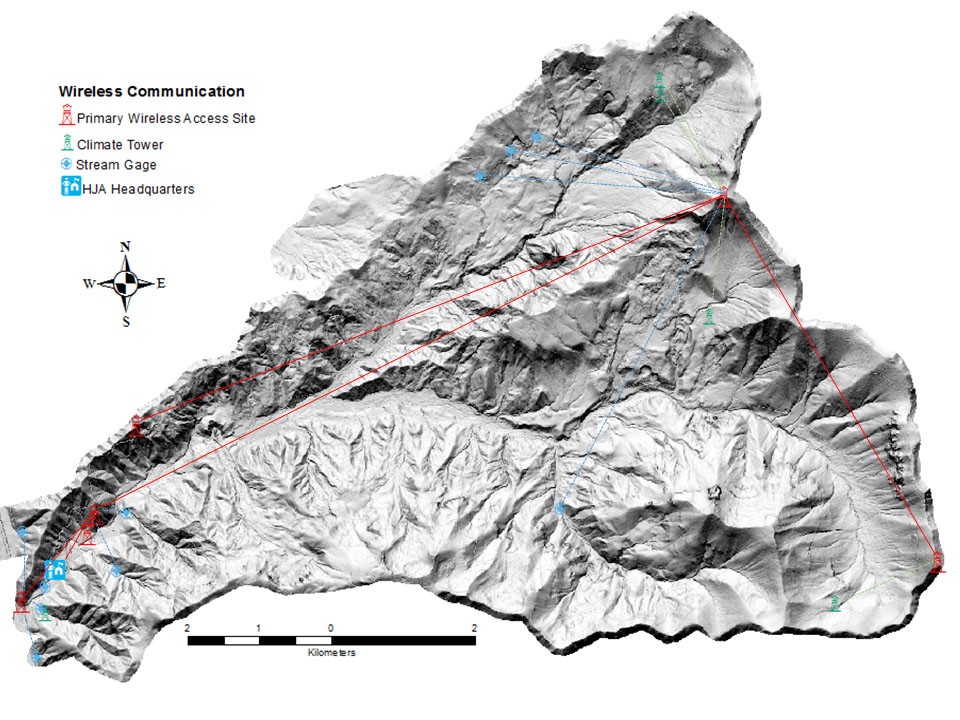
The first generation of radio telemetry was installed in the 1990s to allow for near real-time data streaming and sensor troubleshooting from climate and stream gauging stations. In 2012, the site upgraded its wireless capabilities with a new system of high-throughput radios that link remote research sites to headquarters through a backbone of ridge-top radio towers. This wireless system provides coverage to approximately 80% of the H.J. Andrews Experimental Forest area and enables streaming of larger data volumes generated by modern environmental sensors and digital imagery.
In 2018, a new backhaul link was added, connecting Oregon State University's College of Forestry, in Corvallis, to the H.J. Andrews Experimental Forest. Spanning roughly 100 km of mountainous, complex terrain, this link increased total bandwidth from 1.5 Mbps to over 100 Mbps.
In 2022, a redundant network link was added between Deathball Mountain and the Road 130 backhaul tower. This link currently provides approximately 50 Mbps of capacity.
Note that this wireless communication system does not provide WiFi coverage to the forest, but new research projects can arrange to connect to the wireless system with the appropriate investment in radios (900 MHz or 5.8 GHz) and power supplies for new remote sites. Contact the Andrews Site System Administrator to discuss possibilities.