HJA newt logoHJ Andrews
Login Donate
 
 
  Home > Outreach > Education Program > Higher Education > Undergraduate Research Opportunities

  Undergraduate Research Opportunities

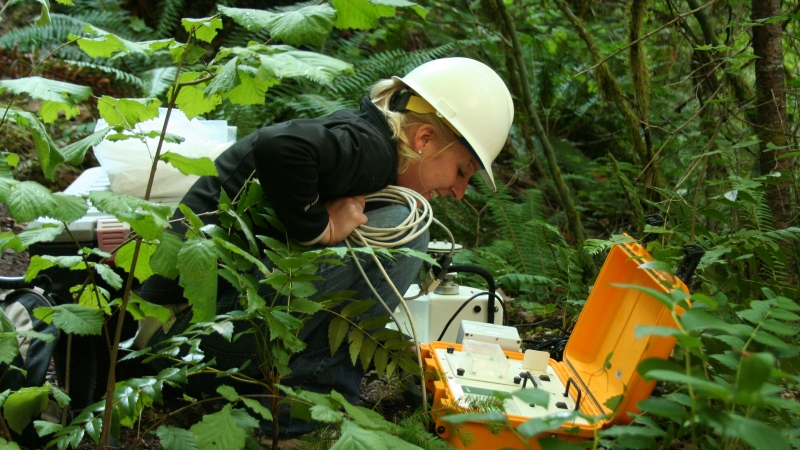
Image of REU student at HJ Andrews (2007), photographed by Claire Phillips

Research Experiences for Undergraduates (REU)

Each year the Andrews Forest supports undergraduate students through the NSF Research Experiences for Undergraduate program (REU). This program supports active research participation by undergraduate students in one of the current areas of study by Andrews LTER scientists and graduate students. Undergraduates in the REU program carry out independent summer research projects with the help of mentor scientists. Please see opportunities for advertisements of REU positions.


Ecoinformatics Summer Institute (EISI)

Students in the EISI enjoy exploring Oregon on weekends between their ecology-math-computer science-engineering research projects.

The Ecoinformatics Summer Institute (EISI) is an NSF-funded REU program intended for undergraduates who are considering graduate study or a professional career in environmental science, computer science, or mathematics. The program is a 10-week field program based at the HJ Andrews Experimental Forest and the OSU campus in Corvallis, Oregon, that provides opportunities for team-based, interdisciplinary research linking ecology, engineering, mathematics and computer science. Over the course of the summers of 2007 to present, the EISI has hosted a total of 60 undergraduate students from all over the U.S., Puerto Rico, and Haiti , where they have worked with faculty mentors on research projects that advance knowledge and understanding of old-growth forests, streams, and other native ecosystems. Example projects include: (1) engineered log jams: connecting fish habitat to wood in streams using advanced imaging technology and visualization; (2) moths and meadows: species distribution models and insect emergence models and field sampling to understand species sensitivity to topography, vegetation and, climate; (3) wood dynamics: modeling and mapping how large wood has moved in streams over the past 40 years and how stream channels have responded; and (4) ecohydrology: modeling and measuring diel fluctuations in streams and their connection to hydrologic flowpaths. Of the 60 students in the EISI from 2007-2011, 10 (17%) have been minority students.

Pollination Biology

Andrews LTER REU Nick Curcio (right) works on soil studies in Watershed 1 at the Andrews Forest

The NSF-funded Pollination Biology REU is hosted by the Department of Crop and Soil Science at Oregon State University, and the H.J. Andrews Experimental Forest is one of the primary field sites for students in this project. This 10-week program provides undergraduates with experience in cross-disciplinary research in pollination biology in natural and manipulated ecosystems.


Undergraduate Student Researchers and Workers

Andrews Forest undergraduate worker inspects an understory plant for insects as part of the phenology project.

Undergraduate student researchers and workers are an integral part of the education and research program at the Andrews Forest. Each year, undergraduate workers are part of long-term vegetation plots monitoring program, which includes forest plots that have been measured since the early 1900s. The bird component of the phenology project trains student interns to be rugged field researchers and proficient point-count samplers capable of identifying all resident and migrant forest bird species song and call. The phenology project as whole has provided ecological work experience for recent graduates who are preparing for graduate studies. Undergraduate students also make major contributions to the Water and Carbon cycling processes project in Watershed 1. The research-management partnership through CCAMP has provided opportunities for students and recent graduates to learn vegetation sampling techniques and silvicultural principles while monitoring forest response to several management treatments (uneven-age management of young forest stands, meadow restoration, using landscape-scale disturbance processes to guide management of young and mature forests) grounded in findings from Andrews LTER Research. The annual field campaigns for the DIRT and NUTNET plots provide valuable field experiences for students. All students who work at the Andrews Forest are trained in field and lab techniques and safety.


For those of you on the OSU campus we also employ student hourly workers in our laboratories and field projects. Please see opportunities for advertisements of summer field positions. February through April is the best time to find these advertisements.

Thinking about a senior project or honors thesis? Why not work on an Andrews related project? Please look over the Andrews LTER PI list in our personnel directory and contact a professor in your department that is associated with the program. If there is no such person then contact the person closest to your interests. We can help you design a project, find matching funds, and submit applications to OSU programs such as URISC (Undergraduate Research, Innovation, Scholarship, and Creativity). We also encourage projects by undergraduate students from colleges and universities throughout the region!