Investigators: Markus H. Weiler, Kevin J. McGuire, and Jeffrey J. McDonnell
Experiment Date: August 6 to 8, 2002
A combined sprinkling and dye tracer experiment was carried out on an H. J. Andrews (HJA) soil to identify major processes controlling infiltration into and through soils containing macropores. Macropores in forest soils are formed by root channels, cracks, animal burrows, and aggregate soil structure. The experiment allowed for the observation of macropore flow initiation and interaction (flow from macropores into the surrounding soil matrix) at high spatial and temporal resolutions. These data will be used to assess basic infiltration processes in places like WS10 and other HJA research catchments.
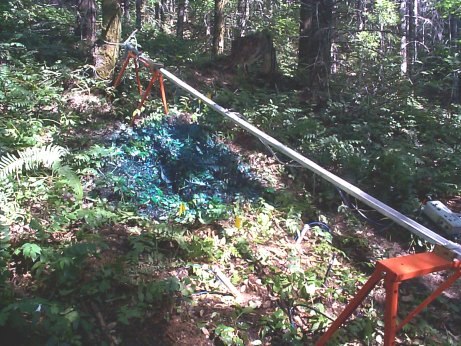
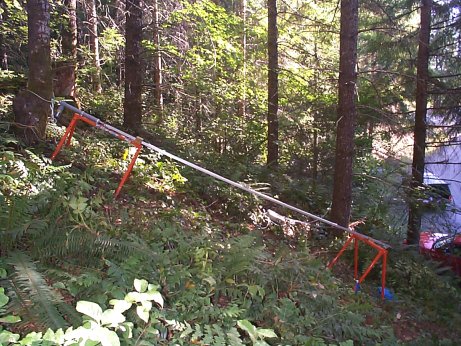
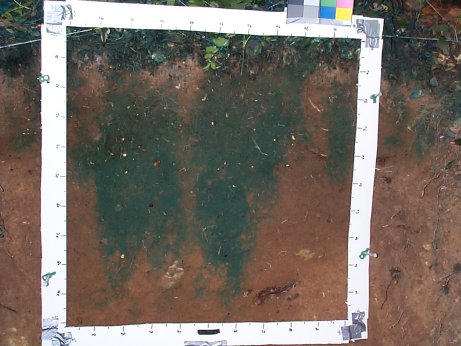
The experiment was carried out on a hillslope above a roadcut (USFS-RD 130) within the HJA Harvest Unit B132. Two adjacent (in slope direction) 1.5-meter irrigation plots were setup on a hillslope and sprinkled for 4.5 hours (110 mm of water, ~25mm/hr). The upper plot was sprinkled by a Brillant Blue FCF dye solution and the lower plot was sprinkled only by water to investigate lateral flow effects. Additionally, soil water content and pore pressure measurements were made at various depths over the course of the experiment. After the sprinkling, several (~12) vertical soil sections were prepared for photographing the dye stained patterns. The images will later be analyzed to calibrate/validate a soil infiltration model (Weiler, 2001).
Weiler and others are replicating this experiment under different antecedent wetness conditions and various sites in the PNW (e.g. Coast Range, OR; burned western Cascade soils; SE Alaska). The work at the HJA will be used in a more detailed hydrologic process study that is part of Kevin McGuire's dissertation project and research program of Jeff McDonnell's group.
The implications of this study are important for hydrological applications. The initiation and interaction between macropores and soil matrix can subsequently affect percolation rates and considerably accelerate the runoff response. The infiltration process can affect the solute dynamics in runoff and the movement of "old" and "new" water in the soil. These studies indicate that runoff generation by macropore flow processes and the resulting heterogeneous distribution of the water content in the soil should be taken into consideration for rainfall-runoff modeling in catchment hydrology.
As results become available, we will post them on our web page.
|
|
Sprinkler setup showing upper dye application and lower water only application
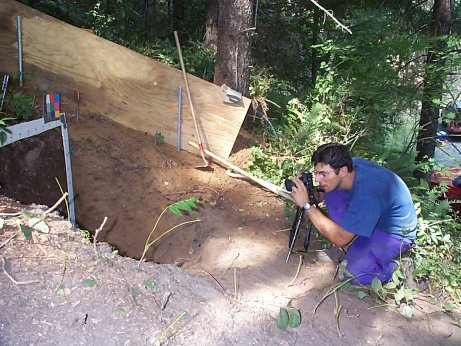 |
Photographing soil profile for image interpretation of dye stains
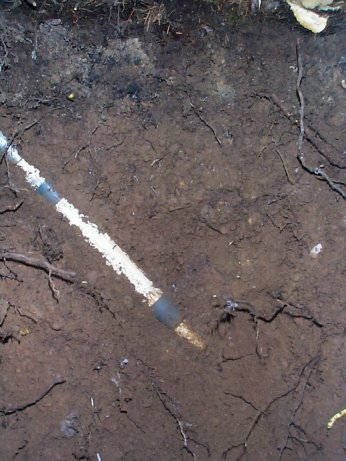 |
Tensiometers and TDR was used during the experiment to monitor soil moisture and pore pressure (tensiometer shown in photo)
 |
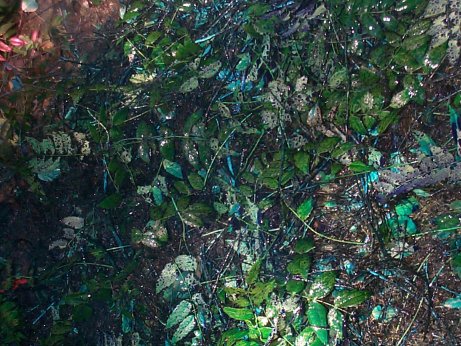 |
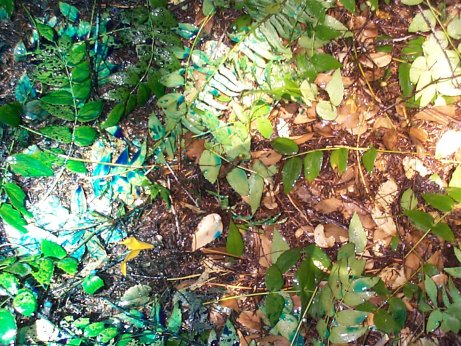
Litter surface under irrigation showing the transition between dyed and non-dyed sections
 |
 |
 |
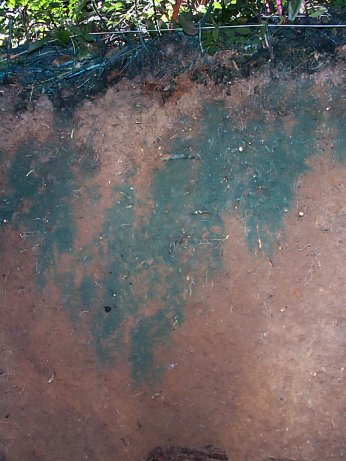 |
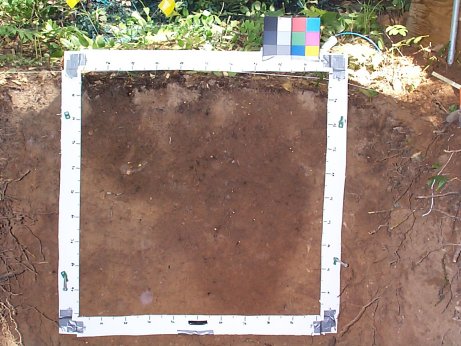
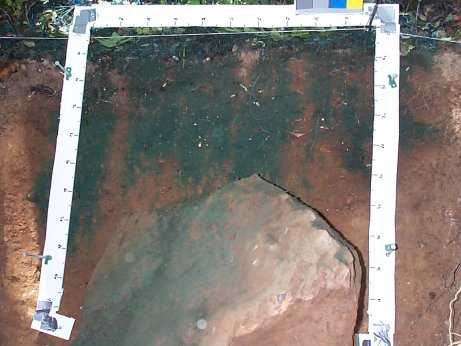
Example photos of successive soil profiles that will be used in an image analysis program to interpret infiltration characteristics. (top left: section without dye; top right: profile containing large boulder that created a preferential flowpath during the experiment; lower left: typical dye stain showing preferential infiltration and areas that did not "wet-up" just below the litter layer; lower right: pronounced bypassing of shallow soils and heterogeneous infiltration)
http://www.cof.orst.edu/cof/fe/watershd/
Weiler, M. (2001) Mechanisms controlling macropore flow during infiltration - dye tracer experiments and simulations. Diss. ETHZ No. 14237, Zürich, Switzerland. [Full text] (PDF 5361 KB)