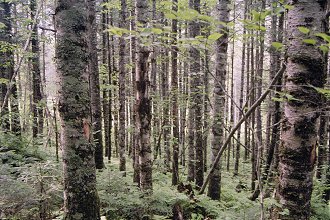
A Chronosequence approach of the study


The study has measured woody detritus decomposition rates using a chronosequence approach. The chronosequence approach is a specific technique of dating pieces of wood that have decomposed various times. There are two major challenges in this approach. The first one has to do with attempts to date or age the pieces of coarse woody debris in various states of decay. In Russia for this purpose we have used: The second challenge has to do with attempts to determine the species of the coarse woody debris. For late decay classes we have used such characteristics for species identification as long-lasting branch stubs in spruce logs, long-lasting bark in pine and larch, specific smell of Korean and Siberian white pine logs that can be detected in branch stubs found in completely deteriorated logs, and the long-lasting bark in white birch logs that stays in the soil even after the entire heartwood and sapwood is gone.

Scars
These scars were made recently by the inventory crew
to mark trees in permanent plots. Healing wounds can
be used in the future to determine the age of snags
forming from the marked trees.
Roadside
Korean pine logs pushed by bulldozer to clean the space
for the road construction in 1965.
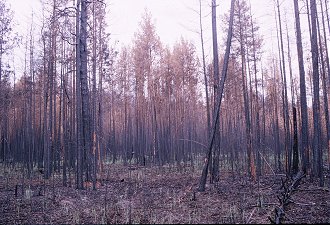
Pine burn
Spring 1997 forest fire recorded in the forest inventory
gives a precise date of forest stand mortality.
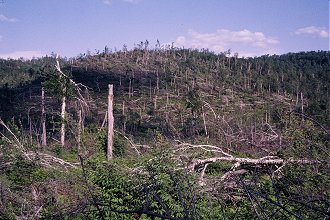
Windthrow
Forest inventory data indicated this stand to be damaged
by windthrow in 1997.
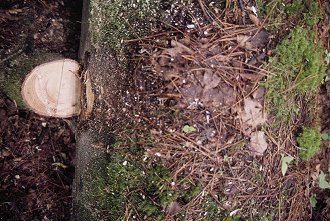
Fallen tree
The scar on the young live tree to the left can reveal when
the nearby tree fell and became a log.
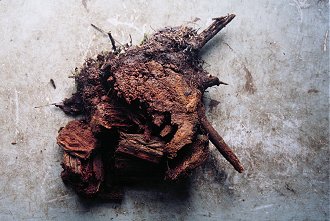
Spruce stabs
Long-lasting branch stubs can be used for identification of
spruce logs in the late decay stage.
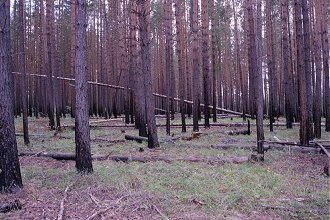
Pine stand
An inventory crew member cut these pine trees in 1972
for taking measurements used in construction of the
growth and yield tables.
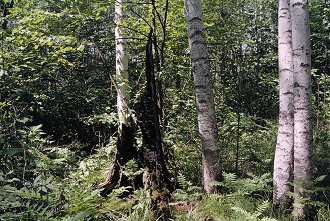
Birch after fire
The age of the catastrophic wild fire can be approximated
from the age of the 65-year old birch trees that established
after the fire.


Questions? Email Dr. Mark Harmon at
mark.harmon@orst.edu or Dr. Olga Krankina at olga.krankina@orst.edu

Back to the Main Page.

Return to the top of this page.